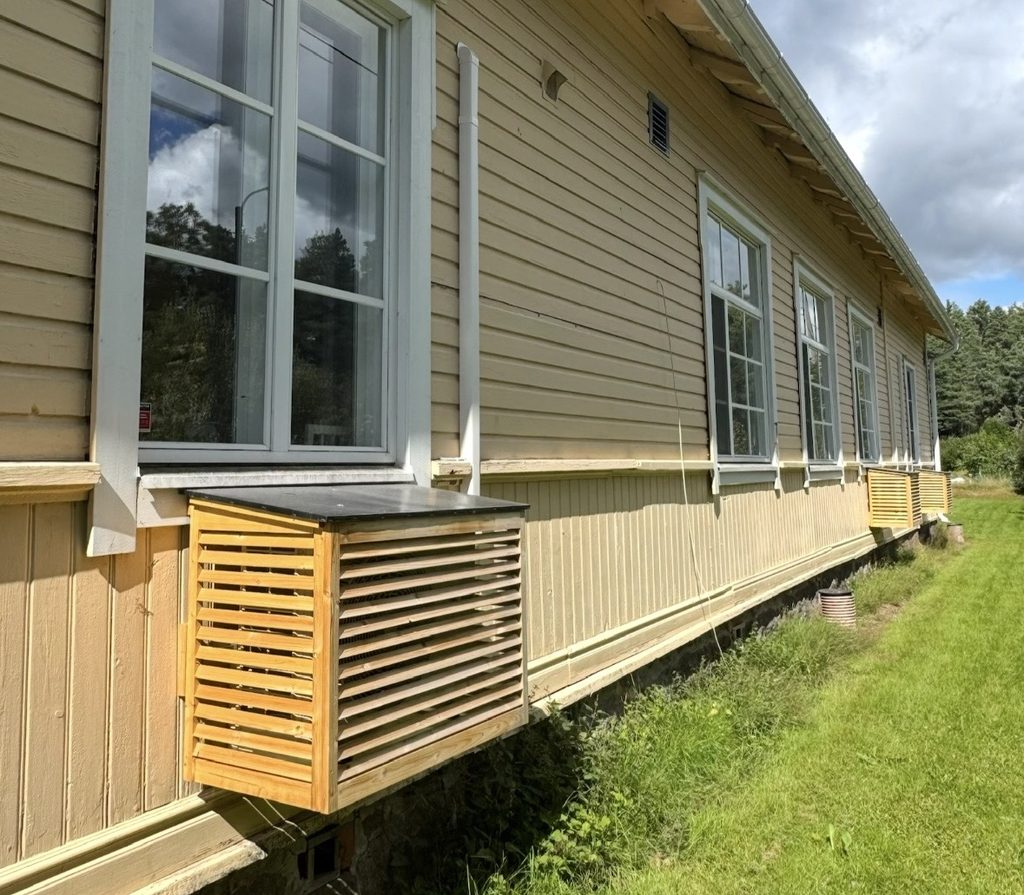
Air source heat pumps improve energy efficiency at the Agricola Building:
Final report on the 2026 climate investment project
In the spring of 2026, the Pernaja Agricola Society, with support from the Uusimaa Region’s Centre
for Vitality’s rural development funding, carried out a climate investment project in which four air source heat pump units were installed in the Agricola House in Pernaja.
The aim of the project was to reduce the costs of direct electric heating, improve heating conditions in the premises and reduce emissions from the property’s energy consumption.
The project was carried out according to plan and the total costs were slightly lower than estimated.
Implementation
The air source heat pumps were installed on 23–24 March 2026. Three units were mounted on the building’s external walls and one in the courtyard. For the units to be placed on the external walls, a planning permission application was submitted, along with a request for an opinion from the Porvoo Museum.
Porvoo LVI-Group was responsible for the installation work, with Hoffes El / Pernaja-Lovisa acting as a subcontractor.
The enclosure work for the pumps and other supporting tasks were carried out by volunteers as part of the association’s self-financing contribution.
In connection with the installation, user training was organised and a maintenance plan was drawn up. Overall, the work proceeded quickly and according to plan. The costs for the electrical work were slightly lower than estimated in the project plan.
Costs:
Equipment € 6,248
Labour € 4,232.15
Total € 10,480.15
The administrative work was not eligible for funding and was therefore carried out by the association itself.
Experience of use
The pumps were tested before spring arrived. Based on the feedback received from the building’s users, the new heating system has improved user comfort on the premises.
The temperature has remained steady, there have been no draughts, and the premises have been maintained at around 20 degrees.
In very cold weather, it is recommended that electric radiators and the building’s wood-burning stoves be used in conjunction with the pumps. During the summer of 2026, there was no need to use the pumps for cooling, but the cooling option will remain available in the future. This can also be used, where necessary, to regulate the temperature and humidity balance in the museum’s premises.
During the initial operating period, no significant problems have arisen with the pumps. Their performance and impact on the building’s electricity consumption continue to be monitored. Regular maintenance visits are arranged with the supplier.
Project impacts
The air source heat pumps are expected to significantly reduce the Agricola House’s heating costs. The project plan estimated the savings target at around 30–40 per cent of heating costs. If these savings are realised, the association’s funds will be freed up directly for its activities and the maintenance of the premises.
A more consistent temperature benefits both the building and its users. It helps to preserve the building’s
structure and maintains conditions suitable for museum premises. This is particularly important as the collection from the archaeological excavations in Pernaja, on loan from the National Board of Antiquities, is stored on the premises.
The Agricola House is an important venue for gatherings and activities all year round in Pernaja. As energy consumption falls and heating conditions improve, the opportunities to use the premises are further enhanced. Comfortable indoor conditions encourage people of all ages – particularly children and the elderly – to take part in the centre’s activities.
Climate action and raising awareness
The project is a concrete climate measure that improves the property’s energy efficiency and reduces the need for electricity for heating. At the same time, the project demonstrates that even individual buildings and associations have the opportunity to take practical climate action.
The Pernaja Agricola Society has informed its members, user groups and visitors about the project. The investment in the air source heat pump has been showcased during guided tours and events, particularly at the ‘Loviisa Open Gardens’ event. Furthermore, the project has been highlighted on the association’s social media and on posters.
The project has attracted interest, particularly from the perspective of energy savings and heating costs. The mitigation of climate change and the opportunities for local communities to participate in climate action have also been highlighted in the discussions.
The climate issue will play an even greater role in Agricola House’s activities going forward. In the ‘Whispers and Shouts’ discussion series, which is being organised this autumn, experts will discuss the global situation and climate change. One of the speakers is Leo Stranius, whose topic is ‘A 1.5-degree better life’.
Summary
The air source heat pump project has been implemented in line with its objectives. The new heating system
improves Agricola House’s energy efficiency, reduces heating costs and enhances user comfort within the premises. At the same time, it contributes to the preservation of the museum’s artefacts and enables the building to be used for a variety of purposes all year round.
The grant awarded to the Agricola Society in Pernaja was crucial to the project’s implementation. Without this support, the investment would have had to be postponed for several years. In addition to the financial savings, the project’s benefits also extend to the preservation of the building, community activities and local climate action.